

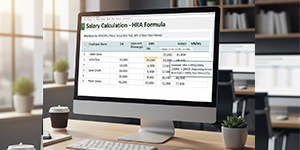
How to Calculate HRA Exemption in Excel (2025 Update) - Step-by-Step Guide
In today’s dynamic work environment, understanding the structure of your salary is just as important as earning it. One of the most critical components of a salary package, especially for employees who live in rented accommodations, is the House Rent Allowance (HRA). HRA not only helps employees manage their housing expenses but also provides significant tax benefits when calculated accurately.
However, manually computing HRA for multiple months or employees can be tedious and prone to errors. This is where Excel becomes an indispensable tool, offering precise calculations, easy formula application, and the ability to handle large datasets efficiently.
Efficient HRA calculation plays a key role in effective tax planning, budgeting and financial management. For instance, knowing exactly how much HRA is exempt from tax can help an employee plan their savings or adjust their rental arrangements. Similarly, for HR and payroll teams, accurate HRA computation ensures compliance with tax laws and prevents discrepancies in employee salaries.
Fortunately, by using Excel, you can implement a structured approach to calculate HRA using formulas, logical functions, and step-by-step procedures. This article will give you the data and resources you need to calculate your HRA correctly and with confidence, whether you are an employee trying to determine your exemptions or a payroll professional with many records.
What is HRA and Why HRA Formula in Excel is it Important?

Employees receive HRA as a portion of their salaries to help with housing rental costs. If claimed under Section 10(13A) of the Income Tax Act of 1961 it also acts as a tax-saving strategy. For organizations and employees to maintain tax law compliance and proper compensation structuring accurate HRA estimates are crucial.
Employees receive HRA (House Rent Allowance) as part of salary to cover housing/rent costs. Under applicable tax laws (e.g. Section 10(13A) in India), a portion of HRA can be exempt from tax when certain criteria are met. Previously many guides computed HRA exemption using just Basic Salary; however, current rules and calculators treat “salary” as Basic Salary + Dearness Allowance (DA) (where DA applies).
That means when comparing thresholds like “50% of salary” or “rent paid minus 10% of salary,” you should consider Basic + DA not just Basic. Omitting DA - if applicable - could lead to incorrect exemption computation.
HRA Calculation Formula in Excel
The HRA calculation Formula in Excel is a straightforward yet powerful way to manage and understand Housing Rent Allowance exemptions. The exempted HRA amount, taxable portions and tax law compliance can all be easily calculated with Excel formulas. For people and HR professionals who wish to automate computations reduce errors and manage wage data effectively this method is perfect. The simplicity and accuracy provided by HRA calculation in Excel make it an invaluable tool for salary structuring and also financial planning. Excel fulfills a variety of objectives in personal and organizational finance by guaranteeing transparency and also usability whether managing individual entries or processing huge datasets. Typically the following rule is used to compute HRA:
HRA Exemption is the minimum of:
- Actual HRA received
- 50% of basic salary (for metro cities) or 40% of basic salary (for non-metro cities)
- Rent paid–10% of basic salary
This formula ensures the exempted amount aligns with tax rules while determining the taxable portion.
How to Use Excel to Calculate HRA:
To calculate HRA formula in Excel take the following steps:
Step 1: Enter Information
Make an Excel spreadsheet with the columns listed below:
- Base Pay (in US dollars)
- Received Actual HRA (in USD)
- The amount of rent paid (in USD)
- Metro/Non-Metro (Yes/No is selected using a dropdown)
Step 2: Establish the Conditions
To calculate intermediate values, add these formula columns:
1. 40% or 50% of the base pay:
=IF(B2*50%, B2*40%), D2="Yes"
2. Rent paid less 10% of base pay is equal to C2-(B2*10%).
Step3: Determine HRA Exemption in Step Three
To determine the exempted HRA amount utilize the MIN function:
=MIN (E2, F2, G2)
Step 4: Determine Your Taxable HRA
Deduct the exempted sum from the total amount of HRA that was received= D2-H2
You may make a solid Excel sheet that precisely computes HRA exemptions by following these instructions.
Example 1: Metro City Employee
Scenario:
- Basic Salary: $50,000
- HRA Received: $20,000
- Rent Paid: $30,000
- Metro City: Yes
Steps in Excel:
- Compute 50% of Basic Salary: =50000*50% = $25,000
- Compute Rent Paid – 10% of Basic Salary: =30000-(50000*10%) = $25,000
- Calculate Exempted HRA: =MIN(20000, 25000, 25000) = $20,000
- Taxable HRA: =20000-20000 = $0
Example 2: Non-Metro City Employee
Scenario:
- Basic Salary: $60,000
- HRA Received: $30,000
- Rent Paid: $35,000
- Metro City: No
Steps in Excel:
1. Compute 40% of Basic Salary: =60000*40% = $24,000
2. Compute Rent Paid – 10% of Basic Salary: =35000-(60000*10%) = $29,000
3. Calculate Exempted HRA: =MIN(30000, 24000, 29000) = $24,000
4. Taxable HRA: =30000-24000 = $6,000
Advanced Use Case: Multiple Employees
Applying formulas across rows allows HR professionals who manage wage data for numerous employees to expand the Excel sheet. For the purpose of monitoring individual computations include columns for employee names and IDs. To draw attention to taxable HRA amounts that over a specific threshold use conditional formatting.
Can We Claim House Rent and Home Loan Simultaneously?
Yes, you can claim both house rent under HRA and home loan benefits under Sections 80C and 24(b) simultaneously. However certain conditions must be met:
- The house for which the loan is taken must not be in the same city as the rented house.
- If the owned house is unoccupied you can still claim the interest deduction while receiving HRA for the rented accommodation.
Additional Tips: Retain proof of rent payments, such as rental agreements and receipts.
How to Calculate HRA on Basic Salary in Excel
Use the following simplified formula in Excel:
=MIN(HRA_Received, Basic_Salary*50% (or 40%), Rent_Paid-(Basic_Salary*10%))
This formula calculates HRA exemptions for tax-saving purposes based on predefined rules.
Excel's Benefits for HRA Formula in Excel
Employees receive HRA as a portion of their salaries to help with housing rental costs. If claimed under Section 10(13A) of the Income Tax Act of 1961 it also acts as a tax-saving strategy. For organizations and employees to maintain tax law compliance and proper compensation structuring accurate HRA estimates are crucial.
Employees who live in rental properties benefit most from HRA since part of their income may be exempt from taxable income which lowers their overall tax liability. Being aware of the HRA formula in Excel and the method to compute HRA can lead to better financial planning and transparency in salary components.
- Efficiency: Time-saving repetitive chores are automated.
- Accuracy: Minimizes human computation errors.
- Capable of managing several personnel records at once scalability.
- Transparency: Enables workers to comprehend their pay scale with clarity.
- Customizable: Modify formulas to account for special exemptions and also pay structures.
Advanced Features for Improved HRA Calculation in Excel
- Pivot Tables: Summaries HRA data for large businesses.
- Macros: Automate the entire calculating procedure for payroll departments.
- Conditional formatting highlights inconsistencies or specified tax thresholds.
- Templates: Develop reusable HRA calculation templates for future use.
Conclusion
Calculating HRA accurately is crucial not only for proper salary management but also for optimizing tax exemptions and maintaining compliance with financial regulations. Excel offers a highly efficient and reliable platform to automate this calculation using the HRA formula in Excel, eliminating the need for manual computations and minimizing errors.
Whether you are handling a single employee’s HRA or managing payroll for a large organization, Excel makes it possible to apply consistent formulas across multiple records, adapt to varying city types and adjust for changes in salary or rent.
From simple examples to more complex scenarios such as claiming HRA while simultaneously paying a home loan Excel allows for precise, seamless, and error-free calculations. The ability to use logical functions, nested formulas, and dynamic cell references ensures that HRA computations remain accurate even as employee details change over time.
By following the step-by-step guides in this article, understanding how to calculate HRA in Excel and implementing advanced techniques like conditional formatting, automated dashboards and scenario analysis, both employees and payroll professionals can save significant time, reduce mistakes and better plan their finances.
Implementing HRA calculation in Excel is more than just a convenience; it is an essential practice for efficient payroll processing, financial transparency and effective tax planning. Mastering this process empowers organizations to maintain consistency, improves employee satisfaction by ensuring accurate salary computation and provides actionable insights for future financial decision-making.
By embracing Excel for HRA calculations, you create a robust, scalable and reliable system that simplifies complex financial tasks and ensures accuracy across all salary components.
Read More: IT Jobs in Vietnam: Salary, Companies, and Career Guide