

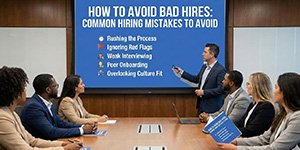
How to Avoid Bad Hires: Common Hiring Mistakes to Avoid
Every organization wants top talent. Yet despite good intentions, many employers repeatedly struggle with bad hiring decisions. There are plenty of people who want to work there; however, the problem is that the hiring process is not structured, disciplined or aware enough. Understanding how to avoid bad hires starting with realizing that hiring people is one of the riskiest things a business owner can do.
When companies experience getting hired wrong, they often blame the candidate. In reality, most failures come from internal recruitment mistakes such as unclear goals, tight deadlines, or interviews with biased people. These sneaky ways of hiring people hurt team morale, lower productivity and make it harder for leaders and workers to trust each other.
The cost of bad hires extends far beyond salary. It includes wasted time during onboarding, teams that aren't working together, missed goals, unhappy customers and the cost of hiring new people. Worse, frequent hiring the wrong candidate tells high workers that standards aren't being followed, which leads to more voluntary turnover.
What makes this issue dangerous is how common it is? Many common getting hired wrong employers make are normalized like "going with your gut," skipping tests or hiring quickly to meet a schedule. Companies keep doing the same things and don't understand why their results don't change.
Learning how to avoid bad hiring decisions needs a change of mind. Hiring people shouldn't be seen as a quick administrative job, but as a long-term investment. Companies that are successful set up hiring processes that are based on proof, structure and long-term fit.
This article provides a practical, no-fluff roadmap on how to avoid bad hires. You’ll learn why companies fail, steps to avoid hiring the wrong employee, proven interview techniques to avoid bad hires, and real-life cases of how to avoid hiring bad people when hiring. This guide is for you if you want to make hiring choices that actually help your business do better.
The Real Cost of Bad Hiring Decisions Goes Far Beyond Money
Many organizations underestimate how damaging bad hiring decisions truly are. Although it's easy to figure out pay and hiring fees, do you understand the bigger picture of things? Hiring the wrong candidate often remains hidden until it is too late. This is why understanding how to avoid bad hires must first have an accurate estimation of exactly how much it will actually expense.
Breaking Down the Cost of Bad Hires
The cost of bad hires Usually comprises three distinct sections:
- Financial Costs: These include advertisements for recruiting interview duration, onboarding expenditures, training resources, as well as expenses for terminating or employing a different candidate. When poor hiring practices happen numerous times repeatedly and the expenses quietly add accumulate.
- Expenses to Operations: Disruptions to operations frequently bring about additional harm than money squandered. Forming decisions takes additional time, projects require longer, and managers possess to focus fewer on strategic goals when they hire the incorrect individual. Companies have to make amends for interrupted work, thereby rendering the whole process fewer successful.
- Cultural and Morale Costs: Culture may disintegrate effortlessly. A single unsatisfactory employee, especially in an upper management position, may damage trust, cause conflict, while rendering performing poorly seemingly normal. This is a long-term consequence of recruitment mistakes that many employers overlook.
Example 1: The High-Performing Resume Trap
A person with an excellent educational record and an impressive resume had been recruited by a company. But when they first started working there, the staff member had trouble working with other people and didn't want to hear comments. Even though that individual had technical skills, they ought to mess up the manner in which the whole group worked. This case illustrates how bad hiring decisions occur when interviews focus only on credentials and not behavior.
Example 2: The “Urgent Hire” Mistake
A growing company rushed to fill a vacancy due to workload pressure. Skipping structured assessments led to hiring the wrong candidate, who additionally stopped in a four-month period. The business spent two times as much on hiring employees and dropped steam during its most important development period. This demonstrates how ignoring how to avoid bad hiring decisions results in long-term problems.
When companies comprehend completely how much it charges when they employ the wrong person, their bodies are more determined to improve the manner in which they employee.
Common Hiring Mistakes Employers Make and Why They Persist
Many businesses continue to perform the same thing regardless of whether they possess access to information and technological resources common getting hired wrong employers make. People don't make these mistakes because they don't belong to smart; they choose to do because they are out of habit, anxiousness and an overall absence of organization.
Why Hiring Mistakes Keep Happening
Hiring people frequently requires to be scheduled and done immediately. When managers put themselves under considerable amount of strain when trying when filling vacant positions quickly, they ought to take expedient measures. These conveniences become accepted as time passes poor hiring practices.
Causes that happen often include the following:
- Failure to expressly establish responsibilities
- Trusting your own feelings excessively
- Inconsistent requirements for interviews
- In addition, being held accountable for how hiring works toward
These conditions create fertile ground for bad hiring decisions.
The Most Common Hiring Mistakes Employers Make
Hiring decisions play a critical role in business success, yet many organizations repeat the same errors during recruitment. These common getting hired wrong employers make frequently cause bad performance, high turnover and higher costs. Knowing about these problems helps companies make better hiring decisions and avoid picking the wrong person.
- Hiring Based on “Culture Fit” Without Defined Criteria: If you rely on culture fit without clear standards, you might make choices that are subjective and unfair. If standards aren't made clear, employers might miss out on qualified applicants, which would decrease diversity. Culture fit should be judged by specific behaviors linked to the job, not by personal preferences.
- Confusing Confidence with Competence: People who are sure of themselves might do well in interviews but not have the skills needed for the job. People often don't do their best because they think that good conversation means they are skilled. Instead of depending on first impressions alone, employers should use structured interviews and tests to confirm skills.
- Ignoring Warning Signs During Interviews: It's important not to ignore red flags like vague answers, a job background that doesn't make sense or bad feelings toward past employers. If you ignore these signs, you might hire the wrong person and have problems with their behavior in the future.
- Letting Personal Bias Affect Choices: unconscious bias can skew hiring decisions and make it harder to get the best people. Most of the time, bad hiring choices are made because of assumptions or similarity instead of objective criteria. Standardized tests and structured conversations can help get rid of bias.
- Skipping Reference Checks: It might save time to skip checking references, but it also raises the risk. References help check out what a candidate says and show how well they've done in the past. Regularly checking references helps keep hiring mistakes from being too expensive.
Each of these getting hired wrong increases the likelihood of hiring the wrong candidate.
Step-by-Step: How to Avoid Bad Hiring Decisions
To systematically improve how to avoid bad hires, these steps should be implemented by organizations:
- Clear up what being successful means: Instead of leaving expectations open to interpretation, be considered clear about what the employee should accomplish.
- Standardize the manner in which you hire people: Consistency cuts away at preconception and makes decisions better.
- Use more than one way to evaluate: Putting together assessments, interviews and other work exercises.
- Keep track of decisions regarding hiring: Being accountable becomes less difficult when you have written records.
- Review the consequences of hiring consistently: Prevent committing the same mistakes alongside employment through acquiring knowledge from mistakes in the past.
These are foundational steps to avoid hiring the wrong employee.
Interview Techniques to Avoid Bad Hires: From Guesswork to Evidence
Interviews continue to constitute the most important and dangerous component of hiring. They make bad decisions regarding employment all the moment because they are lacking structure, which amplifies preconception and perception. It's straightforward to do interviews; it's hard to find ways to render them useful for finding an appropriate prospect.
Why Traditional Interviews Fail
Unstructured interviews often acknowledge characteristics that have absolutely nothing associated with performance:
- Charisma over competence: candidates who are confident sure of themselves can grab attention without having the appropriate qualifications.
- Storytelling throughout evidence: interesting anecdotes are frequently more interesting than findings that are subject to measurement.
- When you tend to choose people who look comparable to the interviewer, this threshold is called similarity predisposition. These pitfalls explain why many organizations struggle with how to prevent bad hires in recruitment, despite multiple interview rounds.
Interview Techniques to Avoid Bad Hires
It can be expensive, time-consuming, and annoying to hire the wrong person. But if they're done right, interviews are still the best way to find the right person. The important thing is to switch from guesswork and gut feelings to organized, evidence-based methods.
- Behavioral Interviews: Pay attention to what has already happened, not what might happen. Ask candidates to explain what happened, what they did, and what happened as a result. Scoring rubrics help make sure that evaluations are consistent and based on proof.
- Situational questions: These are real problems that people face on the job that are used to test their ability to solve them and make decisions. For instance: "What would you be doing if a major project lost half of its budget?"
- Panel interviews: Having more than one reporter lowers the chance of each person being biased. Structured scoring and different points of view make hiring choices more objective.
- 4. Scoring Frameworks: Define the key competencies, give them weights, and be consistent with how you rate prospects. This makes personal feelings into comparisons that can be measured, reducing the chance of hiring the wrong candidate.
Example: Interview Redesign Success
A service company revamped its interviews using behavioral questions and scoring rubrics. Within a year, new-hire performance improved and early turnover dropped demonstrating that improving interview quality is a proven way of avoiding bad hires.
Takeaways That Are Important
To prevent one from making bad job choices:
- Switch from gut feelings to interviews based on information.
- Address questions about behavior and situations.
- Use scoring systems and panel interviews.
- Teach interviewers how they can provide fair and consistent ratings.
These methods make organizations stronger, cut down on the cost of bad hires and boost long-lasting company accomplishments.
How to Prevent Bad Hires in Recruitment Through Better Systems
How to avoid bad hires decisions is not about having one strong interview or a single it's not about making a "gut-feel" choice; it's about making strong, repeatable processes that guide every step of the hiring process. Structured hiring practices help companies keep employees longer, keep them engaged and boost total productivity. They also cut down on the cost of bad hires.
Why Systems Matter More Than Individuals
Even highly skilled recruiters can make mistakes if they operate without structured hiring processes. Hiring choices based only on gut feelings or past experiences are more likely to go wrong, especially when time is tight or there are a lot of people involved.
Strong systems create a framework for consistency, making sure that the same standards are used to rate all candidates fairly. The following actions will help you:
- Determine those with the greatest skills and fit for the company culture
- Clamp down on predisposition in decision-making
- Keep updated records of how well hiring works throughout the years
Example: One company that hired people based on ad hoc interviews hired someone who was very good at technology but had trouble working with others. When a competency-based screening system was put in place, new hires were judged on both their skills and their ability to work with others. This cut turnover by 40%.
How to Prevent Bad Hires in Recruitment
Organizations that effectively prevent recruitment mistakes typically implement a combination of process improvements, technology and training. Key strategies include:
- Competency-Based Role Frameworks: Setting clear standards for the abilities, behaviors, and cultural fit needed for each job makes it easier to compare candidates. Competency frameworks help you compare people in a way that is not subjective but objective. For example, skills needed for a sales job might include being able to communicate well, being resilient and being good at using CRM. By measuring each candidate against these, you can be sure that they meet the goals of the business.
- Keeping track of data on hiring outcomes: gathering and studying data on hiring choices helps find patterns of success and failure. Metrics like dropout rates, performance reviews and time-to-productivity can show you what needs to be changed in the hiring process. Example: A company noticed that candidates hired without structured testing were leaving within six months. Introducing data-driven assessments reduced early turnover.
- Regular Recruiter and Manager Training: Even the best systems fail if recruiters and hiring managers lack proper training. Continuous learning on interview techniques how to avoid bad hires and unconscious bias ensures consistency and improves decision-making.
- Clear Ownership of Hiring Quality: Assigning accountability for hiring outcomes creates responsibility beyond the HR team. Managers who share ownership of candidate evaluation are more invested in avoiding poor hiring practices.
These systems reduce reliance on subjective impressions and prevent costly hiring mistakes.
Steps to Avoid Hiring the Wrong Employee at Scale
To increase hiring while keeping quality high, you need to take deliberate steps:
Step 1: Make Sure Hiring Goals are in Line with Business Strategy
Knowing the company's goals makes absolutely certain that every new employee helps the business succeed in the long run. For instance, if invention is important, test candidates on their ability to solve problems in creative ways.
Step 2: Define Competencies Across All Roles
Standardize role expectations with competency frameworks so every candidate is assessed against the same criteria. This reduces common getting hired wrong employers make, such as overvaluing experience over fit.
Step 3: Look into Why Failed Hires Went Wrong
Look at past hiring mistakes to find trends, like not fitting in with the company's culture, not giving enough skills tests or rushing through interviews. These findings help improve processes all the time. A tech company found that coding tests were too narrow after looking at several failed jobs. Adding more factors to the tests made it easier to hire good people.
Step 4: Keep Improving the Criteria for Evaluation
The way hiring is done should change as the needs of the business do. Review and change test questions, evaluation rubrics and interview questions on a regular basis to represent shifting priorities.
These steps ensure long-term improvement, helping organizations consistently prevent bad hires in recruitment while building a strong talent pipeline.
Conclusion
Hiring mistakes are costly, but repeated bad hiring decisions are avoidable. Successful companies know how to stay away from hiring bad people and treat hiring as a strategic process rather than a transactional employment opportunity.
Implementing structured hiring makes sure that every selection has been grounded on information and are in accordance with the company's objectives. By addressing common getting hired wrong employers make, organizations can reduce risk, improve retention, and build high-performing teams.
Carrying out steps to avoid hiring the wrong employee, incorporating standard interviews, assessments based on skills and straightforward evaluation criteria, for example, makes confident every one of the decisions regarding employment are reasonable and consistent. These practices not only reduce the cost of bad hires but also improve employee engagement, team productivity and overall business outcomes.
Over time, good hiring systems improve the culture of a company, boost its reputation as an employer and make it easier to hire excellent employees. Companies that pay attention to how to avoid hiring bad people can grow with confidence, knowing that their employees will meet both performance standards and the company's objectives.
Ultimately, how to avoid bad hires is not about perfection, it's about following rules, having a strategy, which comes and always getting better. When companies emphasize this first, they become more competitive, strong and capable of to grow over an extended period of time. When you see hiring as a strategic benefit, you can be sure that each new staff member will help the company succeed. These turns hiring from a risk into an essential strength.
Read More: Signs of a Bad Hire & How to Avoid Hiring the Wrong Candidate